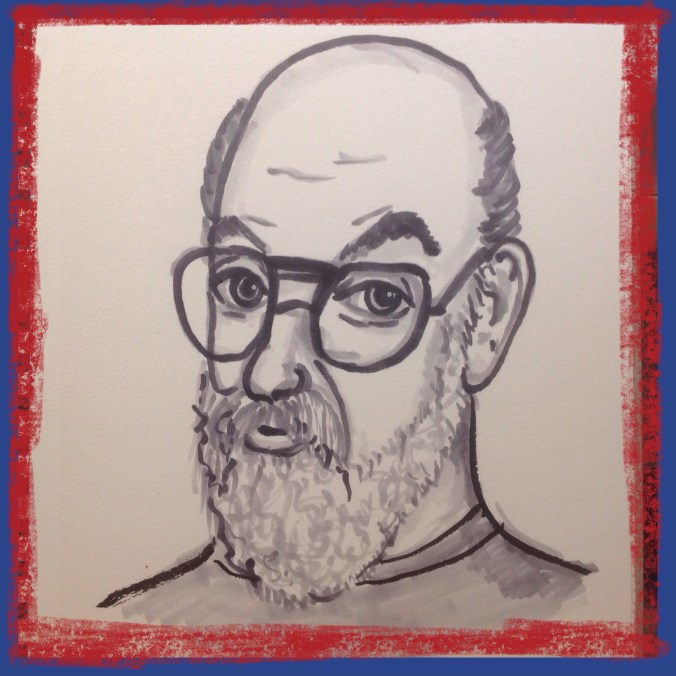
GBR #10: Sharon Lee and Steve Miller

image

I was going to include their cats in this sketch, but frankly my ipad can’t handle that much floofy-ness.

The Great Balticon Readathon continues with a pair of writers who are also a couple: Sharon and Steve have been married, as she says, “for more than half her lifetime.” Their partnership apparently works. They began collaborating in 1979. Not only have they remained married, but they’ve written many novels (she says 17, elsewhere 23, he says “more than 20” … nice sort of problem to have) and more short stories than you could shake a stick at, if you were the sort of person inclined to stick shaking. (I’m not. I just read stories. Sometimes write them. And draw pictures about them.)

Sharon Lee joins our list of the Cat-approved among Balticon Guests of Honor. In addition to serving our genre by catering to our feline overlords, she was Executive Director of the Science Fiction and Fantasy Writers of America, Inc., and then vice president and president of that organization. She is a self-described introvert, which makes her willingness to serve especially generous. She likes Maine, setting five novels and her own self there. Steve likes it too. They say it’s beautiful … and a place freelancers can afford to live. (Yes, I did note this in my Official Record.) Appropriately, it seems that their current cats are Maine Coon Cats. You can find delightful pictures of the Crack Coon Nursing Team on Sharon Lee’s blog. (Search for tag Life with Coon Cats.)

Full disclosure: If I didn’t adore them for living on a Cat Farm, finding out that they’ve got a computer called Number 10 Ox would have won my loyalty. So I’m firmly entrenched at this point.

Steve Miller has a background as a performance poet who got tired of living on beer and started expanding into other writing, including submitting stories to science fiction magazines and fanzines. He also plunged into fandom. He edited a science fiction tabloid, was involved with his local science fiction club (BSFS), and eventually he and Sharon started a genre bookstore with a “traveling convention SF art agency component.” That BSFS connection should make Balticon feel like Old Home Week to Steve!

Attention, novice writers who’d like to travel: Steve says he’s attended “hundreds and hundreds” of conventions, as a fan, writer, and art agent. If I get a chance to talk to the two of them at Balticon, I think I’ll ask them about the practicalities of this. Anything they wish they’d known back at the beginning that would have simplified their travel? And most importantly, do the cats miss them terribly while they’re gone? (Not that I’d know anything about the kind of spite-and-boredom-fueled-toilet-paper-snowstorm that can happen when one relegates cats to the care of sitters…) OK, I’ll ask straight up: is the house more or less intact when you return?

Pretty clever, the two of them, figuring out how to make a living travelling and writing and visiting Most All the Conventions. But then, they are the two of them clever in many ways. Prime example: Sharon kindly linked (sharonleewriter.com) a FREE download of the “quirky little space opera” Agent of Change. The first of the Liaden Universe® novels, replete with charming but lethal protagonists and a deftly portrayed universe for them to live in. Clever, clever. The first one’s free? I think I saw how this works on TV. Because, yes, of course, I downloaded and read the free book. And then started looking around rather urgently for the next. Agent of Change is a solid mix of planet-side and space adventure, touched with humor and suspense both, and graced with understated romance. Lots of action, and well-written dramatic scenarios of large scale and small. I so liked the protagonists! They were multi-dimensional, with strengths and flaws. The story was well balanced between male and female dual protagonists, which was refreshing. And the Turtles? How can you not want more of the Turtles? Well played, Lee and Miller. Well played. You’ve definitely hooked this reader into returning to Liaden.

Next up on GBR: Charles Stross!


GBR #9: Larry Niven

image

Larry Niven’s background, before writing, included mathematics and psychology. He professes “a sense of wonder that’s firmly anchored in the real-world setting of science and technology.” Back in 1966, for example, while I was busy being born, Niven was writing about the newly-described phenomenon of neutron stars. He’s been a prolific writer of short stories and novels, exploring science phenomenon and building universes. Along the way, he’s gathered an impressive number of awards accompanied by critical and fan acclaim.

He’s been inspired by such varied things as a talk with Steven Hawking, and suggestions from his friends Fred Pohl and Norman Spinrad. His subject matter has been as diverse as straight mystery, hard sci-fi, and even three scripts for the TV series Land of the Lost!

(I loved that show as a kid. It stands up to re-watching, too, with surprisingly solid scripts for a Saturday-morning 70’s kid’s show. Not surprising, now that I have some idea of who was working on it. David Gerrold, too?!? Seriously, Land of the Lost will be its own blog post sometime. Sleeeeeeestaks!)

Arguably Niven’s most influential work is the body of material around Ringworld, published originally in 1970. Set in 2850 CE (Earth date), it involves characters from Niven’s Known Space series exploring a world that is an artificial ring approximately the diameter of Earth’s orbit. It was so engaging that he created four sequels and four prequels. Fan involvement with this series is intense, and spawned sequels including Ringworld Engineers and Ringworld’s Children.

Most of Niven’s work in recent years has been in collaboration, including work with Jerry Pournelle, Greg Benford, Edward M. Lerner, and Michael Flynn, as well as previous GBR subject Steven Barnes. He’s allowed other writers to work in part of his Known Space universe, which has led to eleven published “Man-Kzin Wars” anthologies.

Larry Niven’s website includes links to his active fan community pages. If you enjoyed our Readathon entry, Dream Park, you should consider visiting to see what’s up. If past history is an indicator, you may be able to be small part of creating the Ringworld legacy: additional sequels are a definite possibility!


As for me, time is still pressing. So with a final nod to Dream Park, I’m off to read our next book, Agent of Change by Sharon Lee and Steve Miller.


GBR #8: STEVEN BARNES

image

The hardest thing about drawing Steven Barnes?  Imaginary Tananarive Due standing over my shoulder saying, “You have GOT to be kidding me.”

You know what Steven Barnes is probably doing right now?

Writing.

In which area he’d be writing is anyone’s guess. He’s well known for his work in science fiction, television scripts, mysteries, comics, and animation. He’s also written comic books, newspaper copy, and magazine articles. Additionally, as though there needs to be more, he’s a life coach and the author of his Lifewriting™ course, and maintains an active blog that seems to be an active marketing tool. Novice writers, you might check out his online thoughts on marketing yourself and your writing.

A quote from Barnes: “Life is a wonderful, complex, demanding game. The way to win is to decide what you want, focus on that goal, surround yourself with people who will support your dream, and nurture the ability to laugh at yourself.”

With that quote in mind, I chose Dream Park, a story of murder and mayhem in a live-action role-playing adventure game set in the not-so-distant future in a human-constructed environment that’s a fantastic combination of amusement park, extreme adventure trek, and virtual reality. This entry for the Great Balticon Readathon was new to me, a collaboration between Barnes and Niven. This was Barnes’ first published novel. Niven, the senior writer on the project, is the lead author, but Barnes wrote the raw draft. He cites the experience as an intense learning experience, a writing practicum of sorts, with the more experienced Niven acting as master craftsman to help Barnes understand the workings of  a novel.

Characterization is subordinate to plot in this novel, and both of these are secondary to the vision of the interaction of role playing games, live action adventure, virtual reality, and imagined future technologies. You can actually imagine a concept such as the Dream Park being created, which is a sign of a convincingly imagined future. This is the sort of book that will appeal to those who are hungry for a strong visual element and a fast-moving, battle-laden adventure.

One thing I appreciated was the amount of diversity present in the competitors and game masters. It was presented matter-of-factly, which is how it should generally be, with some of the more charismatic and positively portrayed characters casually depicted as non-white. Loved that, especially in a book originally published in 1981.

The novel and its sequels inspired the International Fantasy Games Society, which requested and received permission to use the name of the fictional governing gaming organization created by Barnes and Niven. This group still exists. A real-life Dream Park was attempted, but the organizing company went out of business in 1997. Living near Orlando, and witnessing the development of the major theme parks over the years, I suspect that something similar in scope is not too far in the future. I wonder if Barnes and Niven would attend?

Great Balticon Readathon Progress Report

imageOmystars, folks! Just checking our progress and I have come to an unsettling conclusion: we’re going to have to read FASTER.
My suggestion: cut out the nonessentials. Ironing, for example.

When I set out to prepare myself for Balticon 50, I optimistically thought I’d have time to do the reading, reader responses, brief bios, and still maintain my life and my own writing schedule. BUT… not to be. Each of these blog entries is deceptively short. They probably look as though I’ve just tossed them off. The unseen part: I spend hours researching each author and their works before chosing a book or story, and selecting points to focus on for the post.  And it’s fascinating! But I still have mundane commitments and all the messy, gloriously human things to attend to as well as doing the actual composition and editing. I also have to make a sketch, photograph the sketch, then prep it for online use in the Procreate app. Essentially: a bigger job than I thought it was.

It’s been grand fun…but the clock is ticking. And I still have to pack! Will I make my deadline? If I could get a Batlabel, I would want one that said “Nailbiting Suspense.” Perhaps I should get one? Let me add that to the list.

Are YOU ready for Balticon 50?

Next up: Larry Niven and Steven Barnes propel us through a wild adventure in DreamPark!

GBR #7: Harry Turtledove

imageSomeone at a convention once told Harry Turtledove that they worried whenever a writer quit their day job. “So does the writer,” Turtledove said.

Before making the great leap himself, Dr. Turtledove (Ph.D. in Byzantine Studies from UCLA) used to be a technical writer. I can’t find anything recent online to see if he still keeps this schedule, but he used to maintain a very professional two and a half hours writing per day, 350 days per year, with much of the rest of the day dedicated to research and reading for his work. “If you wait for the Muse to strike,” he has said, “you will starve.”

For the Great Balticon Readathon, I’m jumping back to a collaborative work that he wrote back in 1999 with Dr. Judith Tarr, Household Gods. Tarr earned a Ph.D. in Medieval Studies from Yale. What this collaboration means is that, certainly to a lay person such as yours truly, the world of Household Gods was absolutely convincing.  Yet they managed, between them, to create this immersive experience while avoiding pedantry. They’re not just good historians: they’re good writers.

I spotted this book in hardback on the shelves of a small local library when it was still a fairly new title. I was an exhausted mother of a toddler, trying to find my way in a new neighborhood and a new life situation. The cover design caught me first. I missed reading speculative fiction, and that mode of thought. I was feeling isolated and, frankly, a little overwhelmed. So many day-to-day tasks were absolutely necessary … I was hesitant to check the book out. The description seemed improbable. I wasn’t sure I would like it, and my reading time was so precious.

I began the story impatient with the protagonist, who irritated me. Perhaps she was striking a little too close to home? (Although, for the record: my husband was never the jerk that hers was. I identified with the mommyhood, not the divorce.) I admit, I judged her harshly for her self-absorption. Then again, nobody else was looking out for her … who would if not she herself?

Then the story opened up, and I fell right in. I could hardly put the book down. I stayed up far too late so I could finish it. It turned out to be just exactly the book I needed to read at that time. So exactly that it made me consider having a look around to see if there weren’t some household icon lurking about through which interested deities were acting to bring my unspoken wishes…

Why did I like this book so much? Well, the accuracy of the history, to begin with. Not that I’d have enough knowledge to disagree on specific points, but the authors were so very confident and sure in their portrayal of daily life and larger events in 2nd century Carnuntum, that it never occurred to me to question them. Deft handling. This was not the result of casual scholarship, but consistently showed a real grasp of how that world worked, in detail and in larger scope. I never felt that I was being lectured at, but rather shown a particular time and place and its people.

Our protagonist, Nicole, after unexpectedly time-travelling, reacts much more realistically than such voyagers typically do. It was refreshing. Additionally, there was opportunity for character development. While I never really came to like Nicole, I greatly preferred her post-adventure self. The other characters in the book were individually interesting as well, and even the token shmuck ex-husband has a redeeming moment. Overall, though, the whole plot seems to exist as a frame for the vivid painting of life in history through a modern lens, and it’s brilliant at that job.

This book helped wake my brain up. I was muzzy with mundanities, and Turtledove and Tarr’s well-crafted volume reminded me both of the privilege of my daily situation (Hot water for showers! Laundry done by machine! My Very Own Bath!) and the larger world that reading and, in particular, speculative fiction, could hold open for me. So this volume will always hold a special place in my heart. And I will very confidently read more of Turtledove’s work. I am sure it will be well written, immersive, and that I’ll learn substantially about history. All very good things!

GBR#6: Jody Lynn Nye

image

Because we all know who is REALLY in charge here.

Attention novice writers: there’s a theme I’m noticing about the Balticon 50 previous Guests of Honor. In addition to the multiple awards most of them have accumulated, many of these folks have long lists of works to their names. Jody Lynn Nye is one of these: she has PUBLISHED more than 40 books, and over 120 short stories. And that’s what made it into print. Who knows how many not-quite-right manuscripts are lurking about the place? We know that practice improves any skill, and writing is certainly one of these. The Great Balticon Readathon is showing us people putting that very real work into their craft over years, and what the outcome of that dedication may be. Lesson in plain view: oh, you wrote a book? Excellent! Write another!


In the case of Jody Lynn Nye, one of these outcomes is my GBR pick, View from the Imperium. A delightful and very funny SF novel that is both political and military. I loved our erstwhile protagonist, Lord Thomas Kinago, who is essentially Bertie Wooster in space. Jeeves is there too, even more utterly competent and utterly mysterious. There are wardrobe disputes and social entanglements and missed cues woven throughout Nye’s story of empire management and mismanagement.  Delightful. And the reason people were giving me side-eye me for laughing aloud on the plane a couple of days ago.

This book has been around for a few years now, but contains a bit of prescient parallel to a current political situation. I won’t get into this right now, but I did identify with a particular bewildered political figure (the one with the cat). Can’t be more specific; my son’s been talking with me rather keenly about spoilers. Bad enough I let you know there’s a cat cameo.

But it’s Jody Lynn Nye, for heaven’s sake, of COURSE she’s going to get in a cat if she can. Visit her website and look at the photo gallery for images of her very handsome black cat, Jeremy. I can of course testify to the usefulness of having a large black cat around when writing or reading, as our own Bruce sets the scheduling at the Palmer household. In fact, without Bruce’s substantial presence and keen vocals, I’d not have been up at 5:30 this morning working on this blog post. He reminds me: if I’d kept his schedule from the beginning, I’d likely be finished with the entire GBR by now, and would be free to do what I really wish I could do. That is, follow Lord Thomas Kinago’s further adventures in Fortunes of the Imperium.

So: what would I speak with Jody Lynn Nye about, should I meet her at Balticon? Well, the cats thing is a simple one. If she feels like talking shop, though, I think I’d be interested in hearing her speak about collaboration. In addition to her own solo work, she’s written extensively with other authors, including such notables as Anne McCaffrey and Robert Asprin. A blog post she wrote back in October last year refers to a Publisher’s Weekly article referring to a protégé relationship with Angelina Adams in the “Stellar Guild series, in which a new writer builds on the work of an experienced author”. I would like to hear more about this, and what the experience was like for both of them. Note to self: see if she’s doing a panel!

If you can’t wait to get to Balticon 50 to hear more from Jody Lynn Nye, Doc Coleman over at The Balticon Podcast has an interview with Jody Lynn Nye and Bill Fawcett, replete with insights on publishing, editing, writing, and more. Good stuff!


GBR #5: Allen Steele

image

Allen Steele, drawn in markers on a bumpy airline voyage, rather looks like Mr. Scott on sabbatical from Starfleet.

In 2008, NASA’s unmanned Phoenix lander arrived on Mars. Among its components was nestled an archival silica-glass mini-DVD called Visions of Mars. This multimedia compilation includes a vast legacy of art, sound, and literature: some of humanity’s thoughts about the red planet. Among the many novels and stories is Allen M. Steele’s 1988 debut Science Fiction story, “Live from the Mars Hotel”. This is the work I’ve chosen to explore next for the Great Balticon Readathon.

Allen M. Steele was a journalist before he started publishing Science Fiction. The precision of detail and careful descriptions required for his earlier profession has carried over into his fiction writing. “Live from the Mars Hotel” has for its structure a series of interviews carried out over time, regarding the first musicians to be recorded from a near-future human habitation of Mars. An interesting conceit: it gives Steele the opportunity to use several first-person narrators, to build the story from largely second-hand accounts. Included in this assemblage of second-hand accounts, opinions and conjectures (although perhaps unnoticed), is the reader’s own position at the end of the story. The reader is left to decide which of several possible themes is primary. Is this a story about what home means? The immigrant experience? Corporate interference in the arts? The wellspring of creativity?

Using multiple first-person narrators gives Steele room to create, in a single story, a wide variety of environments. From a radio control room in St. Louis to the isolated Arsia Base on Mars, Steele presents vivid pictures in few words, setting up frameworks for the reader’s mind to fill in. It’s very well done. Minimal but evocative description leaves more space for the leapfrogging of narrators. He then lets a different narrator fill in a bit more description where needed, paint a little bit more of the plot. The story spirals along, rather than falling into a direct line. It requires an engaged reader. Not a bad thing, I think, to have the reader as an active participant in the story.

“Live from the Mars Hotel,” with its easy familiarity with the music and radio industries, was a most fitting entrance into the genre for this guy from Nashville. His lengthy and prolific career has taken him from having a “best young author” tag to being cited by many new writers as a major influence. And who knows which future entity, human or otherwise, will be reading this story, tucked away in humanity’s message on the red planet? If I happen to meet him at Balticon 50, I think I’d like to ask him who he envisions discovering or engaging with that Visions of Mars DVD in the future.

GBR #4: Michael F. Flynn

imageI’m at a loss from the beginning, as Flynn enjoys (as evidenced in his blog) statistical analysis and philosophy and the animated discussion thereof. This doesn’t help me with my “something to talk about at the convention” quest. If I find in my hands something  like a random bead box, I’m much happier arranging the beads into patterns, or wondering who made them and how they got here, than I am forming arguments about them. I’d even enjoy just watching the light play over the beads. So if I happen to meet Michael F. Flynn at Balticon, our natural tendencies in discourse will be very different.

Fortunately for his fans, his very analytical thought processes are not mutually exclusive with an ability to imagine and create. Michael F. Flynn’s many works include subjects as diverse as time travel, alt history, and quantum foam (the drawing above is a joke about that, referencing the story mentioned in the last post). He works in both novels and short stories, committing himself to extensive research when needed to create authoritative prose. Most readers consider his extensive catalog to be “hard” science fiction.  Michael A. Ventrella interviewed him; between this interview and Flynn’s extensive blog, you can get a pretty good picture of Flynn’s thoughts. And they are many, and wide-ranging.